
Rosie the Robot: From Jetsons Icon to Real-World Inspiration for Home Robotics
The Rosie Blueprint: Decoding the Design Choices That Made a Cartoon Robot Iconic
Rosie the robot rolled into American living rooms in September 1962, six decades before the global personal-and-domestic service robot market would reach US$5.6 billion and ship 19.3 million units in a single year, according to the IFR's World Robotics 2023. And yet none of those 19.3 million robots look anything like her. The animated home robot that defined consumer expectations for autonomous domestic help is, by every meaningful engineering measure, a design brief that modern roboticists have spent six decades systematically rejecting.
This is not a nostalgia piece. Rosie the robot remains the dominant cultural reference for what a home robot should be — broad-skilled, conversational, anthropomorphic, always available — but every commercially successful home robot has succeeded by abandoning her design assumptions, not pursuing them. The reasons are technical, and they are knowable. You'll leave with a framework for evaluating any home-robot concept against the constraints Rosie's writers could ignore: locomotion energy budgets, gripper DoF economics, ISO 13482 safety envelopes, and the URDF-based simulation pipelines that today separate buildable robots from animated ones.
Table of Contents
- The Rosie Blueprint: Decoding the Design Choices That Made a Cartoon Robot Iconic
- Rosie's Fictional Constraints vs. the Engineering Reality of Modern Home Robots
- The Humanoid Trap: Why Rosie's Form Factor Is the Wrong Lesson to Take
- The Gripper Problem: Why Rosie's Hands Remain the Hardest Unsolved Problem in Home Robotics
- The Five Archetypes of Today's Home Robot
- From Cartoon to Compilation: How URDF and Modern Simulation Are Building Rosie's Successors
- The Rosie Diagnostic: A 6-Question Framework for Evaluating Any Home Robot Concept
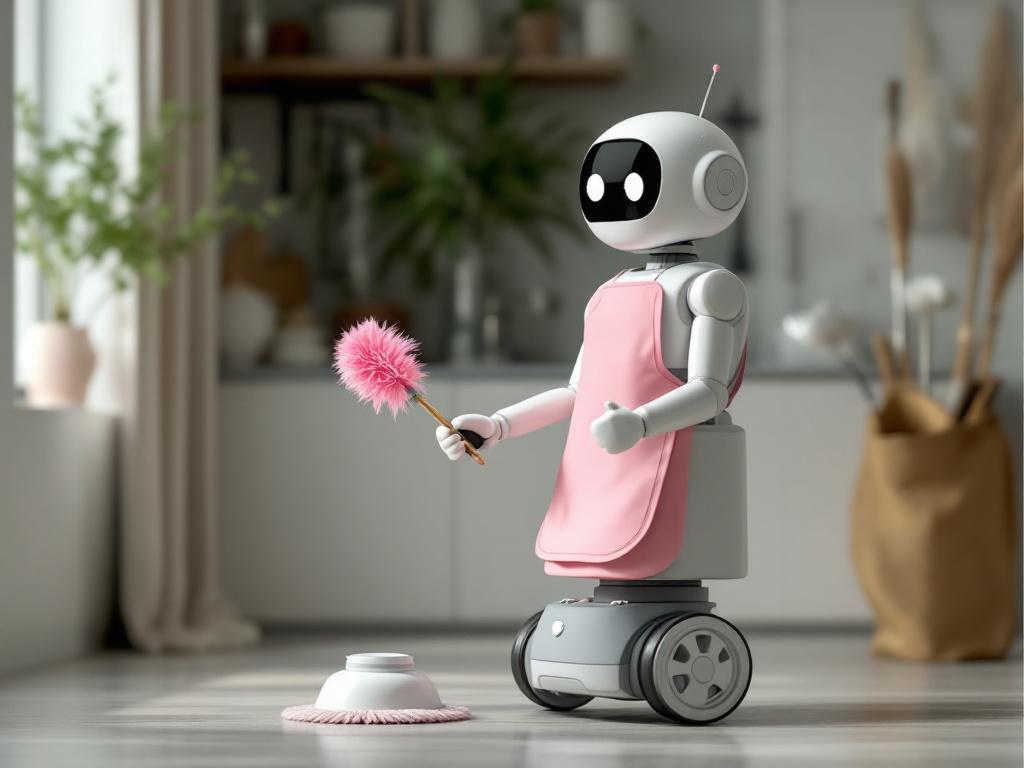
Strip away the apron and the personality, and Rosie is a remarkably constrained piece of industrial design. She has a humanoid torso and an expressive head, but she rolls on a single wheeled base — not legs. This choice was prescient. A 2019 survey by Labbe and Lavoie in IntechOpen's Mobile Robots — Current Trends establishes that "wheeled robots offer significantly higher energy efficiency and simpler control" than legged robots in structured indoor environments. The wheeled base is why every commercially successful domestic robot — from Roomba to sidewalk delivery bots — uses wheels. Hanna-Barbera's animators arrived at the right answer by accident, then American audiences accepted it without protest.
Look at her degrees of freedom. Two arms, a head, a gripper — perhaps 8 to 12 visible DoF in her most animated scenes. Now compare that to humanoid research platforms that routinely exceed 30 DoF with multi-axis leg and arm joints and multi-fingered hands, as documented in Floreano and Mattiussi's Bio-Inspired Artificial Intelligence (MIT Press 2008, Ch. 12). Rosie's apparent simplicity is itself a design feat — her writers intuitively under-engineered her in ways that, decades later, look almost responsible.
Then look at her task scope, and the prescience evaporates. Rosie cooks, cleans, parents, converses, and dispenses ironic commentary at a level that would require, in 2024, four separate product categories and a research lab. No single shipping consumer robot performs more than one of these tasks reliably. iRobot has sold over 30 million Roomba and Braava units — all of them dedicated to one task: removing dirt from floors. Thirty million units, one job.
Her interface design is similarly schizophrenic. Rosie uses voice with visible reasoning ("I'm running low on detergent, Jane"). She has analog dials and indicator lights. Her internal state is legible. This is a sharper design instinct than most 2024 smart-home stacks, which fracture interaction across Alexa, mobile apps, and ambient interfaces with no consistent failure mode. Rosie tells you when she breaks. Your robot vacuum sends a notification you ignore.
Finally, her personality functions as a failure cushion. When Rosie can't do something, she announces it. She doesn't fail silently. This anticipates a principle now formalized in collaborative robotics: ISO/TS 15066:2016 emphasizes legible motion and predictable behavior for cobots operating near humans. A robot that fails loudly is a robot that humans can plan around. A robot that fails silently is a robot that humans return.
Rosie's designers had no engineering budget, no joint limits, no torque curves, no certification regime. They could ignore physics, and they did. Their accidental insight was scoping her to one household, one family, one decade of routines — an implicit specialization that 60 years of commercial robotics has had to rediscover the hard way, and at scale.
Rosie's Fictional Constraints vs. the Engineering Reality of Modern Home Robots
Rosie operated under fictional constraints that mapped — accidentally, in some cases prophetically — onto real engineering tradeoffs. The table below pairs each Rosie design choice with its modern engineering counterpart, citing the standards and surveys that govern real home robots today.
| Design Dimension | Rosie's Implied Solution | Modern Engineering Reality | Governing Source |
|---|---|---|---|
| Locomotion | Wheeled base, flat floor | Wheels dominate; 2-3 powered wheels typical | Floreano & Mattiussi 2008 |
| Degrees of freedom | ~8-12 visible DoF | Research humanoids >30 DoF; consumer <10 | Floreano & Mattiussi Ch. 12 |
| Safety envelope | Trusted implicitly | Power & force limiting required | ISO/TS 15066:2016 |
| Personal-care safety | None (fictional) | Speed/force/contact limits for non-experts | ISO 13482:2014 |
| Consumer certification | Implicit | Required in North America | UL 3300 |
| Energy / runtime | Always-on, AC-powered | 60-120 min battery typical; Roomba i7 ~75 min | iRobot product specs |
| Voice / dialog | Pre-scripted, always-on | NLP mature; always-on causes abandonment | Vincent, The Verge 2019 |
| Gripper | Two-finger anthropomorphic | Parallel jaw dominates (1-2 DoF) | Ghazaei Ardakani 2019 |
Three takeaways are worth pulling out.
The wheeled base was Rosie's most prescient feature. Wheels remain dominant in home robotics because the energy and control penalties of bipedal locomotion in homes are still not justified by task gains. Boston Dynamics' Atlas exists in research videos and viral demos; no consumer home has one, and none will at consumer pricing for years. The IntechOpen survey is unambiguous on this — wheels win for structured indoor environments, and homes are structured indoor environments.
Safety is the silent constraint Rosie never faced. ISO 13482:2014 defines mobile servant robot speed, force, and contact limits for non-expert users. UL 3300 governs North American consumer-robot electrical and motion hazards. Every motion Rosie made in cartoons would, today, require collision detection, power-and-force limiting per ISO/TS 15066, and certification testing measured in months and hundreds of thousands of dollars. The Jetsons had no liability lawyers. Modern home-robot startups have nothing but.
Battery is the hidden killer of the always-on assistant. Rosie was presumed continuously available. A Roomba i7 is rated "up to 75 minutes" per charge according to iRobot product specifications. A Rosie-class mobile manipulator with two arms drawing additional current would, in practice, be lucky to operate 30-45 minutes between docks — a fact no fictional depiction has ever had to address. The robot that does laundry cannot, under current battery chemistry, also stand by the kitchen waiting to fetch eggs.
The Humanoid Trap: Why Rosie's Form Factor Is the Wrong Lesson to Take
The common assumption — louder now than at any point since the 1980s, thanks to venture-funded humanoid platforms — is that Rosie's humanoid silhouette is the goal of home robotics. It is not. It is the trap.
- The uncanny valley penalty is real and measurable. Bartneck et al. (IEEE RO-MAN 2007) ran a 60-participant study showing that participants rated clearly mechanical service robots higher on comfort and trust than near-human designs. Mori's original "uncanny valley" framework, retranslated in IEEE Robotics & Automation Magazine in 2012, formalizes why almost-human robots feel unsettling. Rosie sidesteps this entirely by being obviously mechanical — her face is a friendly cartoon, not a silicone simulacrum. The aesthetic is the engineering.
- Every DoF you add costs actuators, sensors, and certification surface. A research humanoid exceeding 30 DoF requires control software that scales nonlinearly with joint count for trajectory planning, plus sensor fusion across the entire kinematic chain. Consumer manufacturers cannot amortize this complexity against floor-cleaning revenue. The math is not subtle: every extra joint adds a motor, an encoder, a cable harness, a thermal management problem, and a failure mode that legal must approve.
- The form-follows-function path keeps winning commercially. iRobot shipped 30M+ disc-shaped vacuums precisely because the disc is wrong for humans but optimal for navigating under furniture. Boston Dynamics' Spot prioritizes quadrupedal stability and sensor placement over human resemblance, and it sells into industrial inspection. Form follows the task, not the cultural reference.
Rosie won hearts because she was clearly a tool, not a failed human. That mechanical honesty — and its absence in modern humanoid pretenders — is the difference between robots people keep and robots people return.
- Anthropomorphism is interaction, not morphology. Kate Darling's TEDxHoboken 2012 talk makes the case that humans "anthropomorphize machines very quickly" — a Roomba named "Rosie" by its owner is more emotionally Rosie-like than a $200K research humanoid with no personality. The face and behavior, not the body, drive emotional bonding. This is liberating engineering news: you do not need a body to earn the affection.
- The graveyard of humanoid home robots is full. Jibo raised over $73M and launched at $899 before shutting down consumer operations in 2019, as Rachel Metz documented in MIT Technology Review. SoftBank's Pepper saw similar collapse in consumer settings, as James Vincent reported in The Verge. The pattern is consistent: anthropomorphic form raises expectations the underlying capability cannot meet, and the gap between promise and delivery is paid in returns and bankruptcy filings.
The Gripper Problem: Why Rosie's Hands Remain the Hardest Unsolved Problem in Home Robotics
Rosie's gripper is the single most underrated piece of science fiction in The Jetsons. She picks up eggs, folds laundry, pours coffee, and tucks in a child — tasks that span the entire taxonomy of robotic manipulation, from precision grasping of fragile objects to compliant manipulation of deformable cloth to safe physical contact with humans. Sixty years later, no shipping home robot performs more than one of these. The gripper problem has not been solved, and the table below shows why.
| Gripper Class | Degrees of Freedom | Typical Cost (USD) | Best-Fit Tasks | Deployment Status |
|---|---|---|---|---|
| Parallel jaw | 1-2 | $1K-$5K | Structured pick-and-place | Mature, industrial |
| Soft / pneumatic | 5+ (compliant) | $5K-$20K | Fragile or irregular objects | Growing in food, logistics |
| Suction + gripper hybrid | Adaptive | $2K-$8K | Mixed warehouse loads | Emerging in service robots |
| Underactuated multi-finger | 4-8 actuated | $10K-$40K | Adaptive grasping, unstructured | Specialist research, pilots |
| Anthropomorphic multi-finger | 15-24 | $50K-$150K+ | Full dexterous manipulation | Research labs only |
| Shadow Dexterous Hand | 20 actuated, 100+ sensors | $80K-$100K | Benchmark research platform | Lab-only |
Three findings drive everything else.
The DoF cliff is brutal. Catalano et al.'s 2014 review in IEEE Robotics & Automation Magazine and the 2019 Robotics review by Ghazaei Ardakani et al. converge on the same finding: high-dexterity multi-finger hands offer 15-24 DoF but require complex control and high cost, limiting them to research labs. According to packaging from Shadow Robot Company, the Shadow Dexterous Hand offers 20 actuated DoF and over 100 sensors at a list price historically quoted in the US$80K-100K range — orders of magnitude beyond what consumer price points can absorb. You cannot ship a $100K hand on a $1,200 home robot.
Reliability beats dexterity in unstructured environments. Aaron Dollar (Yale) and Robert Howe (Harvard) showed in their 2010 International Journal of Robotics Research paper on the SDM Hand that robust underactuated grippers often outperform more complex multi-fingered hands in unstructured environments. They sacrifice perfect dexterity for reliability. This is the central finding that predicts why consumer mobile manipulators, when they finally ship at scale, will not be Shadow Hands. They will be 2-finger compliant grippers with limited DoF and grasp success rates tuned for a small set of high-frequency household objects.
The manipulation gap dwarfs the locomotion gap. Gill Pratt of Toyota Research Institute told IEEE Spectrum in 2017 that "the hardest problem is reliable robotic manipulation in cluttered human environments…we're still far from a robot that can do dishes or tidying as reliably as a person." Locomotion has improved dramatically since The Jetsons aired — quadrupeds walk, sidewalk delivery robots navigate, vacuums map rooms in real time. Manipulation has not kept pace. The robot that can vacuum your floor cannot fold your shirt.
Rosie's greatest engineering deception isn't that she's fictional — it's that her gripper promised capability that physics and supply-chain economics still cannot deliver, 60 years later.
Until the gripper economics change, home robots will remain bound to tasks that avoid dexterous manipulation: floor cleaning, mowing, delivery, companionship, monitoring. Rosie's hands are the single design element that fiction can ignore and reality cannot.
The Five Archetypes of Today's Home Robot — And Which Slice of Rosie Each One Inherited
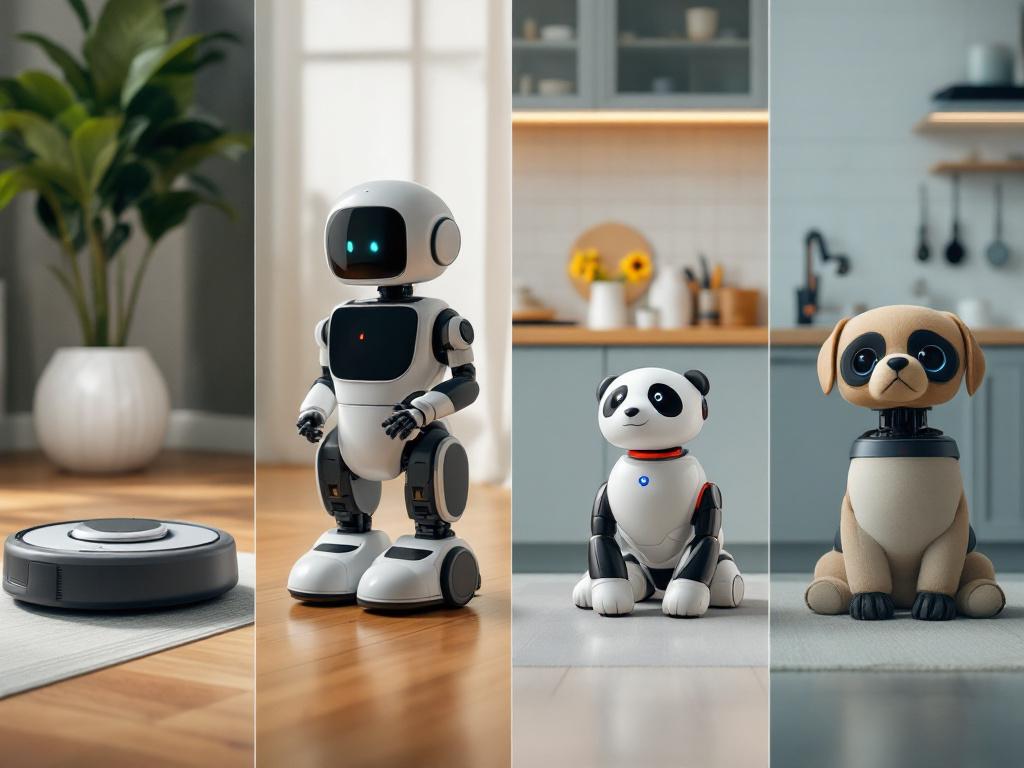
The market did not produce one Rosie. It produced five descendants, each carrying a different slice of her capability and ruthlessly cutting the rest.
- The Generalist (Discontinued Path). Inherited Rosie's conversational range, anthropomorphism, and multi-task ambition. Abandoned: nothing — and that was the problem. Examples: Jibo, Pepper in consumer settings. Jibo raised over $73M and launched at $899 before shutting down consumer operations in 2019. Cynthia Breazeal herself acknowledged in The Verge that science fiction creates "expectations of broad competence" that consumer robots cannot meet. The Generalist path is, in 2024, a path nobody serious is walking.
- The Floor Specialist (Mass-Market Path). Inherited Rosie's wheeled mobility and cleaning task. Abandoned: humanoid form, conversation, arms, face, everything else. iRobot's 30M+ shipped units dominate this category, and the IFR's 19.3M annual figure is driven by it. Consumer Reports notes wide performance variance and the need for human pre-cleaning — cable management, threshold ramps — but the category sells regardless. The Floor Specialist is the only Rosie descendant that has reached genuine mass-market scale.
- The Collaborative Arm (Emerging Path). Inherited Rosie's manipulation ambition. Abandoned: autonomy, mobility, conversation, personality. Examples: Universal Robots UR-series, Franka Panda. These are stationary cobots governed by ISO 10218 and ISO/TS 15066 force limits. They are entering homes via maker labs, accessibility applications, and culinary startups — not as autonomous Rosies but as human-guided tools that occasionally do one task very precisely.
- The Companion (Vertical Path). Inherited Rosie's face, personality, and social presence. Abandoned: the entire physical task suite. Examples: Sony Aibo, eldercare companions, conversational tabletop robots. Success depends on emotional bonding, which Darling's work shows humans extend readily to even functionally limited machines. The Companion does not clean your house. It keeps you company while you clean it yourself.
- The Mobile Delivery Robot (Industrial Path). Inherited Rosie's wheeled autonomy. Abandoned: arms, face, conversation, domestic deployment. Examples: Starship delivery bots, Amazon warehouse drives. Hyper-efficient because they specialize in navigation, not interaction. Notably, they operate outside the ISO 13482 personal-care robot envelope and inside industrial or sidewalk regulatory regimes, which is itself a strategic choice — sidestepping a certification path that would slow them down.
Rodney Brooks — who founded iRobot and ran MIT CSAIL — captured the underlying pattern on his blog in 2017: "You don't want a robot that can do a thousand things poorly; you want one that does one or two things incredibly well." This is the lesson of the 30 million Roombas. Every successful home robot today is a subset of Rosie, not a superset.
Every successful home robot shipping today is a subset of Rosie, not a superset. The market didn't reject her vision — it decomposed her into five companies, each shipping one slice.
The strategic question for any roboticist building a home product isn't "how do we get closer to Rosie?" It is "which slice of Rosie are we taking, and what are we ruthlessly abandoning to make that one slice ship reliably under ISO 13482 at consumer pricing?" Teams that cannot answer the second half of that question do not ship.
From Cartoon to Compilation: How URDF and Modern Simulation Are Building Rosie's Successors
Rosie's writers had no simulation pipeline. They drew her, and physics complied. Modern roboticists building her descendants work the opposite direction — they describe a robot mathematically, simulate it across thousands of scenarios, and only then commit to hardware. The bridge between the cartoon and the buildable robot is the Unified Robot Description Format (URDF), an XML format used in ROS and ROS 2 to describe a robot's links, joints, inertial properties, visual and collision geometry, and joint limits, as documented in the ROS Wiki tutorial on building a visual robot model.
A URDF is what a Rosie design document looks like in 2024. It is the artifact every serious home-robotics team produces before they spend a dollar on hardware. The pipeline below traces how a Rosie-class mobile manipulator concept moves from sketch to deployable robot.

Step 1: Kinematic Description (URDF / XACRO authoring). The roboticist defines every link, joint, and inertial property in URDF or its parameterized XACRO variant. Joint limits — typically ±2-3 rad for revolute joints, velocity limits around 1-2 rad/s for safe collaborative motion, per Articulated Robotics' tutorials — are encoded explicitly. This is where Rosie's implied flexibility becomes a concrete constraint set. The arm cannot reach behind itself if you did not give it the joints.
Step 2: Visualization and Workspace Analysis. The URDF is loaded into RViz or browser-based tools like URDF Viewer for interactive workspace analysis, obstacle insertion, and reachability checks, as described by Black Coffee Robotics. This is where you discover that your mobile manipulator cannot actually reach the top shelf of a kitchen cabinet without colliding with the countertop — a discovery that costs nothing in software and would cost six figures to discover in steel.
Step 3: Physics Simulation (Gazebo, PyBullet, MuJoCo). The URDF drives full physics simulation. Joint state publishers run at 30-100 Hz to feed sensor_msgs/JointState topics to RViz and the simulator. Collision meshes, friction coefficients, and inertial tensors determine whether the simulated robot tips over picking up a cereal box, or drops it. This stage validates that the kinematic plan from Step 1 survives contact with gravity.
Step 4: Policy Training (Isaac Sim, Isaac Lab, RL pipelines). The URDF is converted to richer simulation formats like OpenUSD for NVIDIA Isaac Sim, where reinforcement learning policies are trained for manipulation tasks. The NVIDIA GTC 2024 session by Muammer Bay of LycheeAI walks through exactly this — URDF to OpenUSD to a trained agent. This is where a robot learns to grasp without breaking eggs, the Rosie capability that fiction granted for free and that real engineers spend years training.
Step 5: Hardware Validation and Certification. The same URDF describes the physical robot, and controllers built against the simulation are tuned on hardware. Final products undergo ISO 13482 personal-care robot certification and, in North America, UL 3300 evaluation. A URDF that was sloppy in Step 1 produces a robot that fails certification in Step 5, at the worst possible time and cost.
The reason this pipeline matters culturally — not just technically — is that it makes Rosie's design questions answerable. Can the arm reach the dish? Run the URDF. Will the gripper hold the mug? Simulate the contact. Does the base tip over on a rug? Check the inertial tensor. Every question Hanna-Barbera could draw past, modern engineers can simulate. The cost of being wrong has collapsed; the cost of not simulating has gone up. This is also why curated URDF repositories — peer-reviewed models with documented joint limits, validated collision meshes, and pre-tested compatibility with Gazebo, Isaac Sim, PyBullet, and MuJoCo — have become infrastructure for the field. Teams that start from a verified URDF skip weeks of debugging broken meshes and undocumented joint conventions. This is the role URDF Hub was built to fill.
A URDF is the modern Rosie design document. It is what separates a fantasy from a fundable engineering project — and it is the artifact every serious home-robotics team produces before they commit a dollar to hardware.
The Rosie Diagnostic: A 6-Question Framework for Evaluating Any Home Robot Concept
Apply these six questions to any home robot product pitch, startup deck, research demo, or consumer purchase decision. They translate Rosie's design assumptions into testable engineering criteria backed by current standards and benchmarks. You can run a 30-minute call against this list and form a defensible technical opinion.
- Does the product promise Rosie's breadth — cooking, cleaning, manipulation, and conversation?
Signal: If yes, treat skeptically. The five-archetype analysis above shows that every commercial success is a subset of Rosie. Brooks' formulation applies: one or two things, incredibly well. Ask the team which slice they're committed to and which they're cutting. A team that won't cut anything will ship nothing. A team that names its slice and its non-goals in the first ten minutes is a team worth taking seriously. - What gripper class does it use, and at what DoF?
Signal: Parallel jaw (1-2 DoF) or compliant underactuated grippers (4-8 DoF) signal realistic engineering. Anthropomorphic 15-24 DoF hands signal a $50K-$150K bill of materials with no path to consumer pricing. If the demo video shows dexterous finger manipulation, ask for the BOM and the certification path before believing the consumer price. Specifically ask whether the gripper is a Shadow-class hand or a derivative; if the answer is unclear, you have your answer. - What is the locomotion stack, and what is the battery runtime?
Signal: Wheeled bases with 60-120 minute runtimes are realistic. Bipedal locomotion at consumer pricing signals a research project misrepresented as a product. Legged platforms remain significantly less energy-efficient than wheeled platforms in structured indoor environments — that is a physics statement, not a market statement, and it will not change on the timeline of a Series A. - How does the robot fail — silently, dramatically, or collaboratively?
Signal: Silent failure is the worst case (vacuum missing 30% of the floor without telling you). Robots that ask for human help when uncertain — Rosie's actual model — represent the collaborative-robotics state of the art codified in ISO/TS 15066. Ask the team to describe three specific failure modes and the user-facing behavior for each. If they cannot, they have not stress-tested the product. - What certification path is the robot on?
Signal: Consumer home robots in 2024 should be on a path to ISO 13482 (personal care robots) and, for North America, UL 3300. A team that cannot name its certification path is a team that has not engaged with what shipping a regulated consumer product actually requires. Certification timelines are measured in months and budgets in six figures; teams pretending otherwise are pretending. - Does a URDF or equivalent simulation model exist, and is it public or peer-reviewed?
Signal: In 2024, any serious home-robot program produces a URDF as its kinematic source of truth. Teams that share validated URDFs through curated repositories — with documented joint limits, collision meshes, and sensor configurations pre-tested across Gazebo, Isaac Sim, PyBullet, and MuJoCo — are signaling engineering maturity and inviting peer review. Teams that show only rendered marketing video should be asked to share the URDF and the simulation results. If they cannot, you are looking at a render, not a robot.
Run any home robot through these six questions. If it fails three or more, you are looking at a Jetsons pitch, not a buildable robot. If it passes all six, you may be looking at one of Rosie's actual descendants — finally shipping, 62 years after she rolled into the Jetsons' kitchen with a feather duster and a tone of voice that no consumer product has ever managed to replicate.