
Best Robotics Kits in 2026 — And How to Simulate Them in ROS 2 Before You Buy
Why the Robotics Kit You Buy in 2026 Lives or Dies on Its URDF
You've got purchase approval. The robot arrives next week. The product page promises "full ROS 2 support." But here's what the demo videos don't show you: producing a production-quality URDF/SDF from scratch for a 6-DOF arm takes roughly 1–3 engineer-weeks according to ROS-Industrial tutorials, and porting an existing ROS 1 description forward and validating it in Gazebo runs 3–7 days per ROS migration guides. When you're evaluating robotics kits in 2026, the URDF is the line item nobody scopes — and the one that determines whether you ship in two days or two months.
The stakes are concrete. Global industrial robot installations hit roughly 553,000 units in 2022, per the International Federation of Robotics World Robotics 2023 report, and education and research account for an estimated 20–25% of installations in Europe and North America. Thousands of teams make this kit decision every quarter, and most underestimate the simulation tax. By the end of this article you'll have a 2026 comparison anchored on simulation readiness, a 15-minute URDF validation procedure you can run before issuing a PO, and a future-proofing checklist against ROS distro drift.
Table of Contents
- The Hidden Cost of "Simulation-Ready" Vendor Claims
- 2026 Robotics Kits Worth Simulating — The Verified URDF Landscape
- Matching Robotics Kits to Research Role and Use Case
- The 15-Minute URDF Validation Procedure Before You Issue a PO
- Three Real Integration Timelines After You Unbox
- Future-Proofing Robotics Kits Against ROS Distro and Simulator Drift
- Common Questions About Robotics Kit Selection and Simulation Readiness
The Hidden Cost of "Simulation-Ready" Vendor Claims
"ROS 2 support" on a vendor spec sheet can mean almost anything. On one end, it means the vendor publishes a maintained driver tested against Humble, Iron, and Jazzy, with semantic versioning and an active issue tracker. On the other, it means an engineer committed a URDF in 2021 that hasn't been touched since the team reorganized. The benchmark that actually matters is REP-2000 — the ROS Enhancement Proposal that defines target platforms and quality levels for ROS 2 packages. A vendor either meets that bar or doesn't. Marketing pages aren't evidence.
The failure modes of scattered GitHub URDFs are predictable enough to enumerate. Absolute mesh paths that resolve on the original author's laptop but break the moment you clone. Collision geometry exported at visual mesh resolution — 200,000+ triangles per link — which drops Gazebo simulation to 0.3× real-time and makes any contact-rich planning task impossible. Joint limits copied verbatim from datasheets but never validated against hardware behavior, so the robot oscillates or self-collides on the first trajectory. Sensor transforms where camera_link or lidar_link is parented to the wrong frame, silently breaking SLAM. And URDFs written for ROS 1 catkin builds that never survive the colcon transition without manual surgery.
The counter-evidence from ROS-Industrial is blunt. Independent maintainers have repeatedly documented that vendor-provided "ROS-ready" models are often minimally tested and lag behind firmware or mechanical revisions, producing broken controllers or inaccurate joint limits — see the ROS-Industrial consortium issue trackers for the UR, ABB, and KUKA repositories. Brian Gerkey, co-founder of Open Robotics and lead on ROS and Gazebo, has emphasized in ROSCon keynotes that accurate robot description is foundational: planning, perception, and control stacks cannot be validated against an incorrect model. Put another way, the URDF is the contract between hardware and every layer of your software stack. Break the contract and every downstream component inherits the error.
The discovery cost is what wrecks project timelines. When a URDF is missing or broken, here's what teams actually do: GitHub-search across four to six forks looking for the variant that compiles; email vendor support and wait 48–72 hours for a reply; post on Stack Overflow and ROS Discourse; manually decimate meshes in Blender or MeshLab to get collision geometry down to something Gazebo can simulate at real-time; estimate inertial parameters from CAD when the original author shipped placeholder <inertial> tags. None of this is scoped into the project plan because nobody put it there. It shows up as schedule slip, and the slip gets blamed on "integration complexity" rather than the upstream cause.
Peer review changes the economics. A model verified against Gazebo, Isaac Sim, PyBullet, and MuJoCo before publication — with documented joint limits, collision meshes, and sensor configurations, licensed under MIT or Apache 2.0 — eliminates roughly 90% of the failure modes above. That's the transactional payoff URDF Hub is built around: the model passed peer review, so you don't spend the week of unpaid debugging that scattered GitHub URDFs guarantee.
The robot you buy is only as useful as the simulation model you can run it in. A kit with perfect hardware specs and a broken URDF is a kit that won't accelerate your timeline.
2026 Robotics Kits Worth Simulating — The Verified URDF Landscape
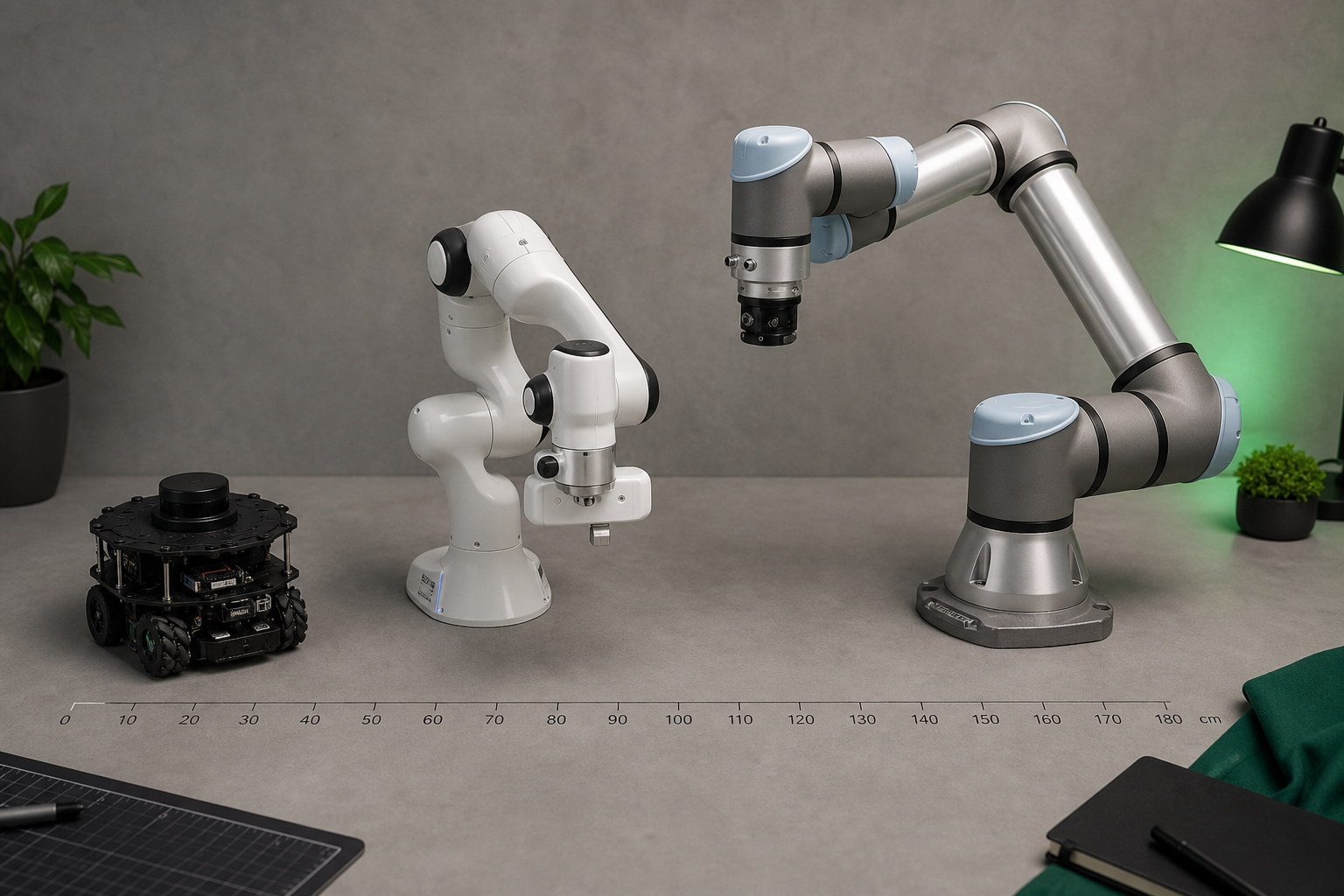
Collaborative robots account for about 7–8% of annual industrial robot installations per IFR World Robotics 2023, but they dominate the verified-simulation column because they're the platforms research labs publish against — meaning their URDFs get peer-reviewed in print before anyone ships them. The kits below earned their place by surviving that scrutiny.
| Kit | Type | URDF Availability | Verified Simulators | ROS 2 Distro Support |
|---|---|---|---|---|
| UR5e / UR10e | 6-DOF cobot arm | Verified + ROS-Industrial driver | Gazebo, Isaac Sim, PyBullet, MuJoCo | Humble, Iron, Jazzy |
| Franka Emika Panda | 7-DOF research arm | Verified + FCI packages | Gazebo, Isaac Sim, PyBullet, MuJoCo | Humble, Iron |
| TurtleBot3 (Burger/Waffle) | Differential-drive mobile | Verified + ROBOTIS official | Gazebo, Isaac Sim, PyBullet, MuJoCo | Humble, Iron, Jazzy |
| KUKA LBR iiwa 7 / 14 | 7-DOF industrial cobot | Verified + ROS-Industrial community | Gazebo, Isaac Sim | Humble, Iron |
| Boston Dynamics Spot | Quadruped | Community + vendor SDK (closed sim) | Limited Gazebo, partial Isaac Sim | Bridge experimental |
| ABB GoFa CRB 15000 | 6-DOF cobot | Community ROS-Industrial; RobotStudio | Gazebo (partial) | Humble (community) |
| Emerging humanoids | Bipedal | Mostly absent or vendor-locked | None standardized | Fragmented |
Collaborative manipulators dominate the verified column for one reason: they're the platforms cited in ICRA, IROS, and JMLR sim-to-real reinforcement learning papers. Jan Peters' group at TU Darmstadt uses Franka Panda and KUKA arms precisely because their dynamics and joint limits transfer cleanly to real hardware. When a model gets cited in a hundred papers, errors get found and patched. That's a peer-review mechanism the open-source community has been quietly relying on for a decade.
TurtleBot3 is the outlier in the mobile category. ROBOTIS explicitly positions it as the standard education and research platform for ROS 2, shipping with complete URDF, Gazebo worlds, and ROS 2 launch files maintained by both ROBOTIS and the Open Robotics community. The LIDAR, IMU, and camera frames are defined correctly out of the box. For a $300–$500 platform, that's an exceptional level of simulation maturity.
The caveats matter. Boston Dynamics' Spot provides excellent hardware and a mature SDK, but the official simulation tooling is closed and community URDFs are incomplete — see the Spot SDK documentation. You can build real-world applications against Spot, but expect to absorb the simulation gap as project risk. ABB's RobotStudio is excellent but proprietary; the open ROS-Industrial ABB packages lag behind firmware and frequently need manual adjustment of tool frames and collision geometry.
Emerging humanoid platforms — Tesla Optimus, Figure, Unitree H1, and their peers — have no peer-reviewed open simulation models as of 2026. Selecting these for a project that requires simulation-first development is a high-risk choice. Budget at minimum 2–3 weeks of URDF construction from CAD specs; humanoids carry 25+ degrees of freedom, well beyond the ROS-Industrial 1–3 engineer-week benchmark for a 6-DOF arm.
Vendor ROS 2 support is not the same as a verified URDF in production simulators. Always confirm peer review and multi-simulator testing before committing the purchase order.
Matching Robotics Kits to Research Role and Use Case
The previous section told you which kits have verified URDFs. This one tells you which kit to pick for which job. Rows are kit categories; columns are practitioner personas. Cells are specific recommendations grounded in research data, not invented options.
| Kit Category | Academic Researcher | PhD Student | Industry Engineer | RL Engineer |
|---|---|---|---|---|
| Cobot arm | Franka Panda | UR5e | UR5e / UR10e | Franka Panda |
| Mobile robot | TurtleBot3 Waffle | TurtleBot3 Burger | Custom + TB3 sim | TurtleBot3 Waffle |
| Industrial cobot | KUKA iiwa 14 | UR10e | UR10e | KUKA iiwa 14 |
| Quadruped | Spot (accept gap) | Avoid | Spot via SDK only | Avoid |
| Humanoid | Wait or build URDF | Avoid | Avoid for 2026 | Avoid |
For university educators specifically, the safe collaborative-arm choice is UR5e (widely documented teaching material, safer envelope than UR10e), and the safe mobile choice is TurtleBot3 Burger (lowest cost, complete URDF, Nav2 tutorials built around it).
The diagonal pattern is the story. Collaborative arms and mobile robots — across nearly every persona — sit in the green band where verified URDFs concentrate. The bottom rows collapse to "avoid" because simulation maturity hasn't caught up to hardware availability. If your project plan depends on simulation-first development, those red cells are blockers. If you can absorb hardware-only iteration, treat them as yellow.

Educators should pay the 20–30% premium for a verified-URDF kit, and the reason is empirical. Steve Macenski, the ROS 2 Nav2 stack maintainer, has repeatedly observed that navigation bugs are usually rooted in incorrect transforms, frames, or robot geometry rather than algorithm design — see the Navigation2 documentation and his ROSCon talks. For undergraduates, a broken URDF means a week of debugging frames before they can run their first Nav2 demo. That's a curriculum-killing experience. Verified URDFs convert that week into a working lab session.
RL engineers face a sharper version of the same problem. Jan Peters' group at TU Darmstadt has shown in ICRA and IROS publications that accurate dynamics and joint limits in simulation are critical for policies to transfer to real hardware without significant performance drop. Training a manipulation policy requires millions to billions of timesteps in MuJoCo, PyBullet, or Isaac Sim. Burning that compute against an inaccurate URDF produces brittle policies that fail on contact. The wasted GPU-hours typically exceed the cost differential between a verified-URDF kit and a community one within the first training run.
The timeline implication is the closing argument. A kit from the green diagonal saves 2–3 engineer-weeks of URDF work versus a bottom-row kit, anchored to the ROS-Industrial benchmark. On a 12-month research budget that's roughly 4–8% of total engineering capacity recovered just from kit selection. Multiply across a multi-platform research program and the savings compound to months.
The 15-Minute URDF Validation Procedure Before You Issue a PO
Run this procedure on any candidate kit before the PO leaves the lab. Each step has a time budget and a binary pass/fail criterion. If a step fails, you know the cost of the next step.
1. Check URDF Hub first (1 minute). Search URDF Hub by exact kit name. If listed, the model has been peer-reviewed against Gazebo, Isaac Sim, PyBullet, and MuJoCo, with documented joint limits, collision meshes, and sensor frames. Pass criterion: model exists with a current ROS 2 distro tag (Humble, Iron, or Jazzy). If it passes, you can stop. The remaining steps exist for the case where it doesn't.
2. Check the vendor's GitHub organization (2 minutes). Look for an official _description or _ros2 repository. Pass criteria: a commit within the last 12 months, issues tagged ROS 2 or Gazebo that receive maintainer responses, and a README referencing a current ROS 2 LTS distribution. Each LTS gets 3–5 years of support per the ROS 2 Distribution Timeline, so a repo pinned to Foxy in 2026 is functionally abandoned. Fail this step and move to step 3 expecting work.
3. Smoke-test the URDF in Gazebo locally (5 minutes). Clone the repo and run ros2 launch <pkg> view_robot.launch.py or the equivalent. Watch the console for missing .stl or .dae mesh errors. Confirm the robot spawns at the origin without falling, drifting, or flipping. Confirm collision geometry renders as low-polygon shells distinct from the visual meshes. Fail any of these and the URDF is not production-ready — it's a starting point that needs work.
4. Verify the ROS 2 launch and TF tree (3 minutes). Run ros2 run tf2_tools view_frames and inspect the generated PDF. Pass criteria: every sensor frame (camera_link, lidar_link, tool0, ee_link) has a parent in the chain back to base_link; no disconnected sub-trees; no NaN transforms. Macenski's point — that Nav2 bugs are usually TF bugs — applies equally to manipulation. A broken TF tree breaks everything downstream.
5. Inspect collision meshes versus visual meshes (2 minutes). In Gazebo, toggle collision visualization. Pass criteria: collision shells are visibly simpler than the visual meshes (capsules, convex hulls, or decimated geometry); no gaps between adjacent links; no inter-link interpenetration at the home configuration. This step is the one that decides whether grasping, motion planning, and contact-rich tasks will work or fail intermittently for reasons nobody can debug.
6. Confirm community signal (2 minutes). Search GitHub issues for "Jazzy," "Gazebo Garden," "Isaac Sim." Pass criteria: open issues have maintainer responses within 30 days; closed issues outnumber open ones; at least one paper or thesis cites the URDF. Katherine Scott, Developer Advocate at Open Robotics, has emphasized that shared and maintained open robot models are what make experiments reproducible across labs — community signal is a leading indicator of model survival.
If a kit fails any of steps 3 through 6, you have two choices. Budget the 1–3 engineer-weeks ROS-Industrial documents for building a production URDF from scratch, or pick a green-row kit from the comparison table earlier. Run this entire procedure before the purchase order. Most vendors will share a sandbox URDF on request — and if they won't, that itself is a signal worth weighing against the line item.
Three Real Integration Timelines After You Unbox
Time-to-first-development varies by a factor of ten depending on the kit's URDF maturity. The three scenarios below cover the realistic span.
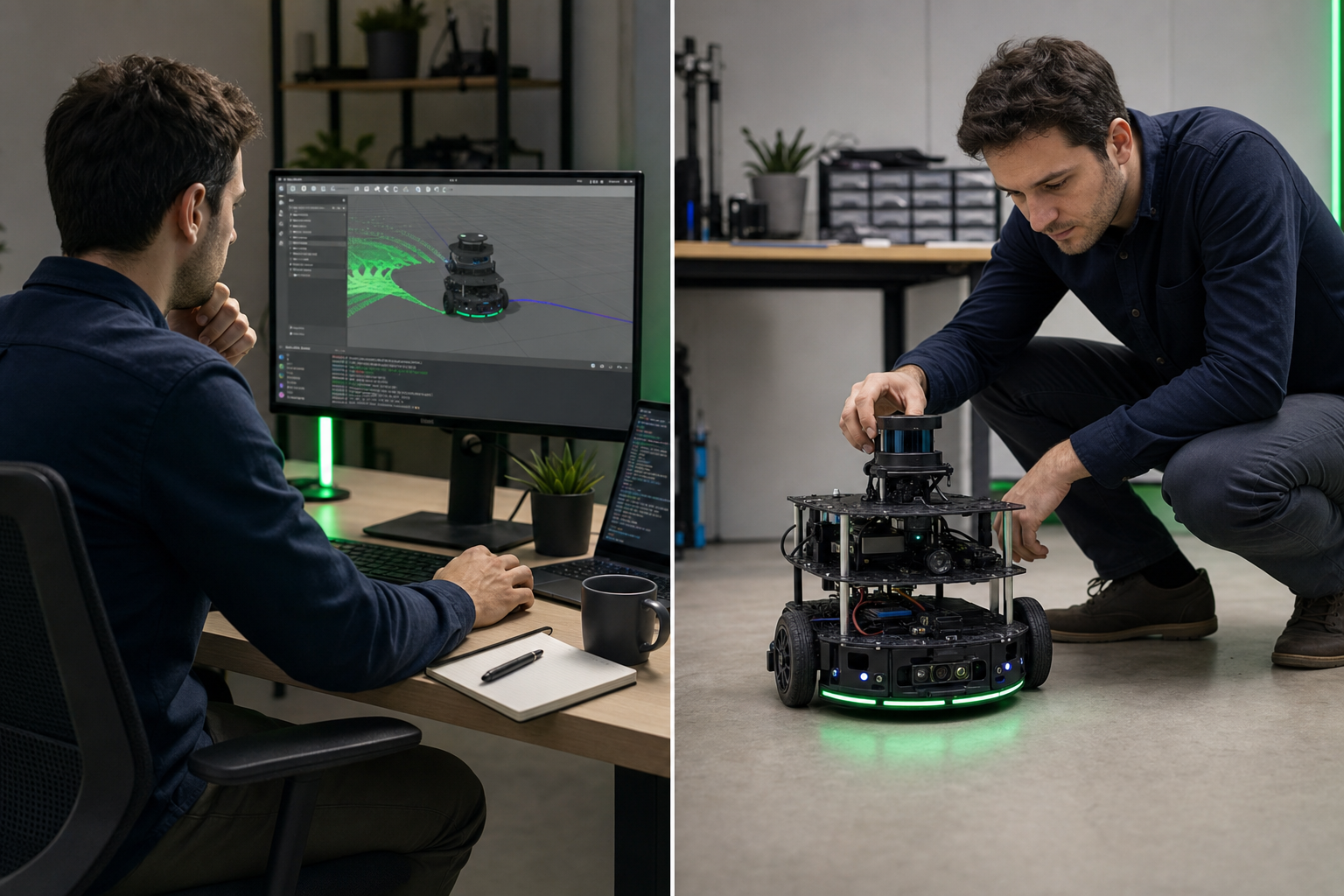
Scenario A — Kit with a verified URDF model (UR5e, Franka Panda, TurtleBot3, KUKA iiwa 14). Day 1: unbox, download the verified URDF, run the included ros2 launch file against your target distro. Day 1–2: cross-check joint ranges and sensor offsets between sim and real hardware. Because the model ships with documented joint limits, this is a verification pass rather than a debug pass. Day 2–3: begin manipulation, navigation, or perception development. Total time-to-development: 2–3 days. This is the floor — you can't move faster because hardware unboxing and network setup are irreducible. Industrial ROS adopters report simulation-based development reduces real-robot testing time by 50–80% in typical manipulation and navigation projects per NVIDIA Isaac Sim and PickNik Robotics case studies, and that benefit compounds when you start from a verified URDF.
Scenario B — Kit with a vendor-provided URDF (recent, maintained). Day 1–2: request the URDF from the vendor, download, audit against the 15-minute validation procedure. Day 2–3: fix predictable issues — absolute mesh paths, missing inertial tags, sensor frames offset from the documented values. ROS-Industrial maintainers have documented that vendor-provided "ROS-ready" models are often minimally tested and require these manual fixes. Day 3–5: rebuild launch files for your specific ROS 2 distro; this maps to the documented 3–7 day ROS 1 → ROS 2 port window from the ROS migration guides. Total time-to-development: 5–7 days. This is the modal experience for ABB GoFa, recent Franka firmware revisions, and most cobots from secondary vendors.
Scenario C — Kit with no public URDF or an outdated community model. Day 1–3: GitHub forensics across forks, vendor email threads, scraping old robotics theses for parameter values. Day 3–10: reverse-engineer the URDF from CAD specs, mechanical drawings, and inertial estimates — ROS-Industrial benchmarks this at 1–3 engineer-weeks for a 6-DOF arm. Day 10–15: validate in Gazebo, repair collision and inertial bugs, integrate with ROS 2 controllers. Total time-to-development: 2–3 weeks, sometimes longer. This is the expected path for emerging humanoids, niche industrial arms, and any kit where the vendor treats ROS as a checkbox rather than a commitment.
Scenario A saves roughly 10–18 days versus Scenario C on a single kit. Across a year of multi-platform research — three or four kits in rotation — that's about 1.5 to 2.5 engineer-months recovered purely from kit selection discipline. When you're comparing two robotics kits and one is $4,000 more expensive but ships with a peer-reviewed URDF, the math is rarely close: two engineer-weeks at a fully-loaded research engineer rate exceeds that delta in most US labs.
A robotics kit without an actively maintained URDF is like buying a car with an incompatible navigation system. It works today, but the moment the standard shifts, you're stranded.
Future-Proofing Robotics Kits Against ROS Distro and Simulator Drift
Drift is the long-tail cost nobody puts on the comparison spreadsheet. ROS 2 LTS distributions each receive 3–5 years of support per the Distribution Timeline. Gazebo has moved from Gazebo Classic 11 through the Ignition rebrand to the current Fortress/Garden/Harmonic generation. A URDF written and tested against ROS 2 Foxy and Gazebo Classic in 2021 may silently break under Jazzy and Gazebo Harmonic in 2026 — plugins renamed, SDF tags deprecated, message types refactored. Nothing about your hardware changed. Your simulation just stopped working.
This is a kit-selection problem, not a software problem. Your choice of kit determines whose problem URDF maintenance becomes. Platform-maintained models are reviewed quarterly against the latest LTS and major simulator releases. Vendor models depend on the vendor's commercial interest in ROS — UR, ROBOTIS, and Franka have demonstrated long-term commitment, but plenty of vendors haven't. Single-researcher community URDFs typically go unmaintained within 12–24 months of the publication that motivated them. Archived repositories are functionally dead and will fail within one LTS cycle.
The maintenance taxonomy is worth keeping in your head when evaluating any kit:
- Platform-maintained: quarterly review against latest ROS 2 LTS and major simulator releases. Lowest drift risk.
- Vendor-maintained (UR, Franka, ROBOTIS): updated when the vendor ships new firmware or hardware variants. Medium drift risk, dependent on commercial alignment.
- Community-maintained on personal GitHub: typically abandoned 12–24 months after the publication. High drift risk.
- Archived or read-only repositories: functionally dead. Very high drift risk.
You can assess drift risk before purchase using four signals. Commit cadence: any commit in the last 6 months is positive; nothing in 18+ months is a red flag. Issue resolution rate: maintainers responding to "Jazzy compatibility" issues within 30 days indicates a healthy repo. Citation count: URDFs cited in five or more papers or theses have community pressure keeping them alive — Scott's reproducibility point in operation. Vendor commercial signal: is the vendor actively shipping new ROS 2 driver releases tied to firmware updates, or did the ROS organization page last update three years ago?
Five protective strategies reduce your exposure once the kit is in the lab. Lock dependencies explicitly: pin the ROS 2 distro, Gazebo version, and URDF commit hash in a Dockerfile or rosdep manifest. Reproducibility on day 1 isn't reproducibility on day 365. Run URDF tests in CI: ROS 2 CI pipelines commonly execute headless simulation tests on every commit, budgeted at 5–15 minutes per run according to DevOps talks from Open Robotics, Fetch Robotics, and PickNik. Adding a "spawn robot + run trajectory" smoke test catches drift the day it happens, not the week before a paper deadline. Prefer kits with peer-reviewed URDFs: if the model is maintained by a platform or by a vendor with ongoing ROS commercial commitment, drift is somebody else's problem. Contribute fixes upstream: when you patch a URDF, submit the PR. This keeps the model alive in the community and reduces your future maintenance burden. Maintain a backup kit: for multi-year curricula or research programs, having two kits with verified URDFs — say, UR5e and Franka Panda — means a broken release on one platform doesn't halt the program.
The cheapest robotics kit becomes the most expensive when its URDF goes unmaintained. Long-term simulation maintenance is a hidden line item that belongs on the kit comparison spreadsheet alongside hardware cost, warranty, and lead time. Most procurement processes never put it there, which is exactly why kits with abandoned URDFs keep getting purchased.
Common Questions About Robotics Kit Selection and Simulation Readiness
What if the robotics kit I want isn't on a verified URDF platform yet?
Not every kit is listed — verified-URDF platforms prioritize open-source and active research platforms with sufficient community demand. For unlisted kits, work the sequence: check the vendor's GitHub organization for an official _description repo; search ROS-Industrial repositories for community models; run the 15-minute validation procedure on whatever you find. If all three sources fail, your options are to budget 1–3 engineer-weeks for URDF construction per the ROS-Industrial benchmark, or to request the model on a community-driven URDF platform — popular kits typically attract contributions within weeks.
I'm teaching ROS 2 to undergrads. Cheapest kit or verified-URDF kit?
Verified-URDF kit, even at a 20–30% hardware premium. Macenski has documented that navigation bugs are usually rooted in transforms and robot geometry, not algorithms — so a broken URDF surfaces as cryptic TF errors that derail an entire teaching week. The safe choices are TurtleBot3 for mobile (ROBOTIS-maintained URDF, full Nav2 tutorial ecosystem documented at the TurtleBot3 e-manual) and UR5e or Franka Panda for manipulation. The hardware premium is recovered within the first week of class time saved.
We're training RL policies. Does URDF accuracy matter, or is any fast simulator fine?
Accuracy matters for sim-to-real transfer. Jan Peters' group and others have shown in ICRA and IROS publications that accurate dynamics, joint limits, and mass distribution are critical for policies to transfer without significant performance loss. Training policies requires millions to billions of timesteps — running that against an inaccurate URDF wastes compute and produces brittle policies that fail on contact-rich tasks. Use a peer-reviewed model in PyBullet, MuJoCo, or Isaac Sim. Verified-URDF platforms test for physics fidelity across all three so you don't have to.
Can I adapt a verified URDF model to similar hardware I already own?
Sometimes. If your hardware is mechanically a close analog — for instance, a generic 6-DOF cobot resembling a UR5e — you can fork a verified URDF and modify joint limits, link lengths, and mesh paths. Expect roughly 2–5 days of CAD-to-URDF work plus validation against the 15-minute procedure. This is much faster than starting from scratch (the 1–3 engineer-week ROS-Industrial benchmark) but requires CAD familiarity and willingness to validate dynamics empirically. Don't skip the validation step — adapted models often inherit subtle errors from the source.
How often are verified URDF models updated against new ROS 2 distros and simulator releases?
Update cadence tracks usage. Heavily used models — UR5e, Franka Panda, TurtleBot3 — see review and update cycles every 1–3 months, aligned with ROS 2 LTS releases (Humble, Iron, Jazzy, each supported 3–5 years per the Distribution Timeline). Less popular models update less frequently but are still reviewed against major Gazebo and Isaac Sim releases. Check the model's commit history on the repository for the precise cadence on any specific kit before you build a long-term project plan around it.